





-
采用静电悬浮技术研究了四元Fe75.6Nd10Y9B5.4合金的亚稳和稳定液态热物理性质及快速凝固规律, 其最大过冷度达到221 K (0.14TL). 精确测定了液态合金密度、热膨胀系数和比热与辐射率之比随温度的变化规律. 分子动力学模拟表明, Nd和Y两种稀土元素扩散系数均随温度下降以指数形式减小, 但相同温度下前者扩散速率高于后者. 当过冷度为80—158 K时, 初生(Nd, Y)2Fe17相枝晶生长速度从3.8 升高至5.7 mm·s–1, 且晶粒尺寸显著细化. 同时, 包晶转变也被促进, τ1-(Nd, Y)2Fe14B相体积分数增长至75%. 一旦过冷度达到180 K, 初生(Nd, Y)2Fe17相消失, τ1相直接从合金熔体中形核, 且生长速度随过冷度由2.6 增大至11.0 mm·s–1. 形成焓计算结果表明, Y元素固溶可以提升初生(Nd, Y)2Fe17和包晶τ1相的热力学稳定性, 所以两相内Y元素含量均显著高于Nd元素. 大过冷条件下, 扩散能力强的Nd元素在τ1相内的含量略微升高, 而Y元素含量下降.
-
关键词:
- Fe-Nd-Y-B合金 /
- 静电悬浮 /
- 亚稳液态热物理性质 /
- 快速凝固组织演变
The metastable and stable liquid state thermophysical properties and rapid solidification mechanism of quaternary Fe75.6Nd10Y9B5.4 alloy with a maximum undercooling temperature of 221 K (0.14TL) are investigated using electrostatic levitation technique. The measured results indicate that the density, thermal expansion coefficient and the ratio of specific heat to emissivity of the liquid alloy comply with linear functional relationship with temperature in the range of 1402–1618 K. Molecular dynamics (MD) simulations show that the diffusion coefficients of Nd and Y elements decrease exponentially with temperature decreasing, with the former exhibiting a larger diffusion coefficient at the same temperature. When the liquid undercooling rises from 80 to 158 K, the growth velocity of primary (Nd,Y)2Fe17 phase dendrites increases from 3.8 to 5.7 mm·s–1, while exhibiting significant grain refinement effect. Meanwhile, the increased undercooling also promotes peritectic transformation, leading the volume fraction of peritectic τ1-(Nd,Y)2Fe14B phase to reach up to 75%. Once the undercooling reaches 180 K, the former peritectic τ1 phase, rather than the primary (Nd,Y)2Fe17 phase, becomes the leading phase, which nucleates and grows directly from the undercooled liquid alloy, and its growth velocity increases with undercooling from 2.6 to 11.0 mm·s–1. The calculation results of formation enthalpy show that the solid solution of the Y element can enhance the thermodynamic stability of the (Nd,Y)2Fe17 phase and the τ1 phase, thereby explaining the reason why the content of Y element in both phases is significantly higher than that of Nd element. Nevertheless, the content of Nd element in the τ1 phase slightly increases because its diffusion ability is stronger than that of Y if undercooling is higher than 180 K.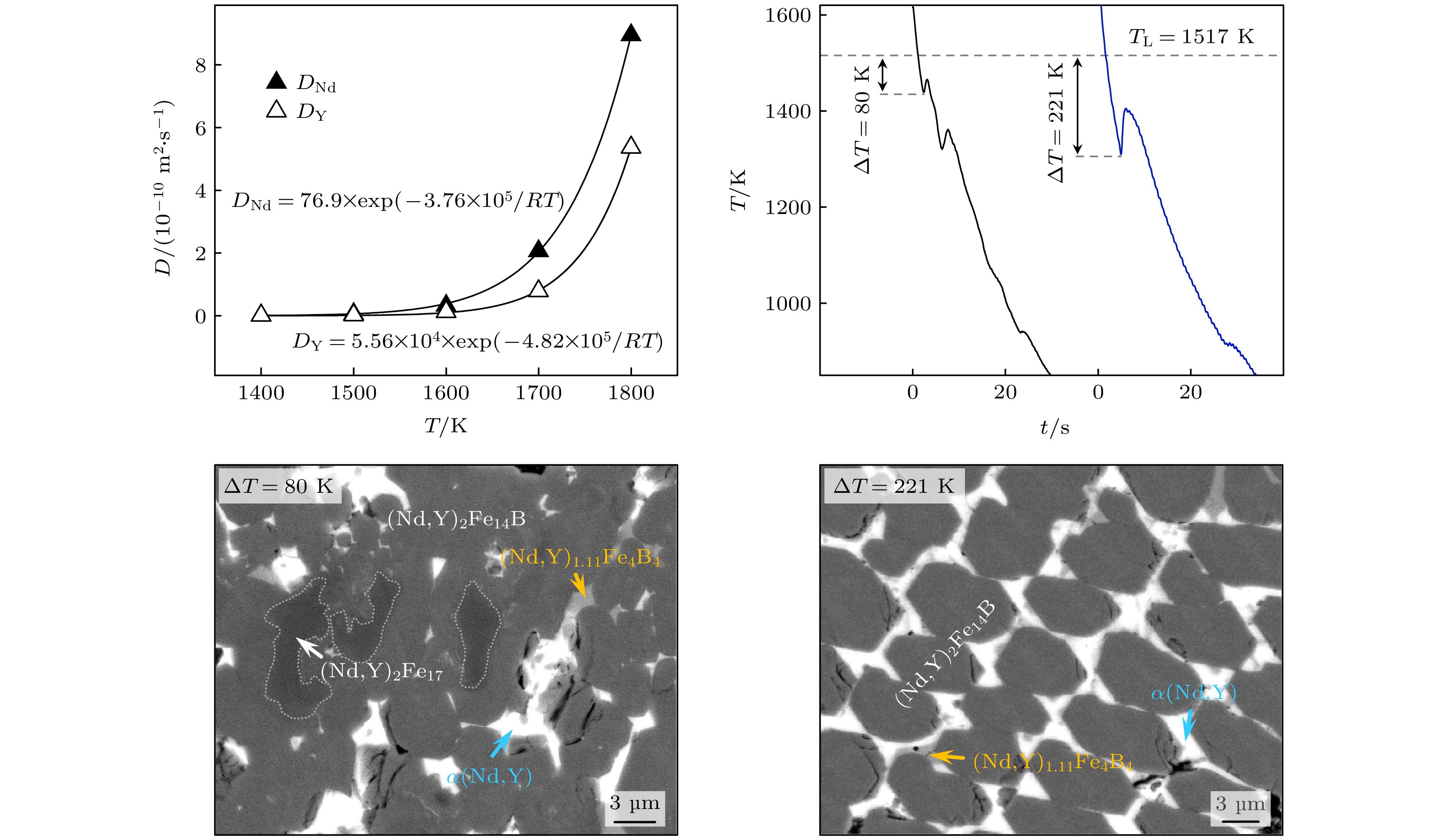
-
Keywords:
- Fe-Nd-Y-B alloy /
- electrostatic levitation /
- metastable liquid state thermophysical properties /
- rapid solidification microstructure
[1] [2] [3] [4] [5] [6] [7] [8] [9] [10] [11] [12] [13] [14] [15] [16] [17] [18] [19] [20] [21] [22] [23] [24] [25] [26] [27] [28] [29] [30] [31] [32] [33] [34] [35] [36] -
Structure Lattice (Exp.) Refs. Lattice (Calculations in this work) A/Å b/Å c/Å a/Å ea/‰ b/Å eb/‰ c/Å ec/‰ Nd2Fe14B 8.800 8.800 12.200 [33] 8.819 2.16 8.818 2.05 12.253 4.34 Nd2Fe17 8.567 8.567 12.443 [34] 8.641 8.64 8.641 8.64 12.560 9.40 Y2Fe14B 8.760 8.760 12.000 [35] 8.775 1.71 8.775 1.71 12.018 1.50 Y2Fe17 8.520 8.520 12.380 [36] 8.584 7.50 8.584 7.50 12.378 0.16 注: eX (X = a, b, c)是计算结果相较于实验测定结果的计算误差.  下载: 导出CSV
-
[1] [2] [3] [4] [5] [6] [7] [8] [9] [10] [11] [12] [13] [14] [15] [16] [17] [18] [19] [20] [21] [22] [23] [24] [25] [26] [27] [28] [29] [30] [31] [32] [33] [34] [35] [36]


 下载:
下载:


计量
- 文章访问数: 1535
- PDF下载量: 40
- 被引次数: 0