




Precision spectroscopy of few-electron atoms and molecules


2024, 73 (20): 202101.
doi:10.7498/aps.73.20241063
Abstract +

2024, 73 (20): 203103.
doi:10.7498/aps.73.20240683
Abstract +
2024, 73 (20): 203301.
doi:10.7498/aps.73.20241064
Abstract +
A molecular hydrogen ion HD+, composed of a proton, a deuteron, and an electron, has a rich set of rovibrational transitions that can be theoretically calculated and experimentally measured precisely. Currently, the relative accuracy of the rovibrational transition frequencies of the HD+molecular ions has reached 10–12. By comparing experimental measurements with theoretical calculations of the HD+rovibrational spectrum, the precise determination of the proton-electron mass ratio, the testing of quantum electrodynamics(QED) theory, and the exploration of new physics beyond the standard model can be achieved. The experiment on HD+rovibrational spectrum has achieved the highest accuracy (20 ppt, 1 ppt = 10–12) in measuring proton-electron mass ratio. This ppaper comprehensively introduces the research status of HD+rovibrational spectroscopy, and details the experimental method of the high-precision rovibrational spectroscopic measurement based on the sympathetic cooling of HD+ions by laser-cooled Be+ions. In Section 2, the technologies of generating and trapping both Be+ions and HD+ions are introduced. Three methods of generating ions, including electron impact, laser ablation and photoionization, are also compared. In Section 3, we show the successful control of the kinetic energy of HD+molecular ions through the sympathetic cooling, and the importance of laser frequency stabilization for sympathetic cooling of HD+molecular ions. In Section 4, two methods of preparing internal states of HD+molecular ions, optical pumping and resonance enhanced threshold photoionization, are introduced. Both methods show the significant increase of population in the ground rovibrational state. In Section 5, we introduce two methods of determining the change in the number of HD+molecular ions, i.e. secular excitation and molecular dynamic simulation. Both methods combined with resonance enhanced multiphoton dissociation can detect the rovibrational transitions of HD+molecular ions. In Section 6, the experimental setup and process for the rovibrational spectrum of HD+molecular ions are given and the up-to-date results are shown. Finally, this paper summarizes the techniques used in HD+rovibrational spectroscopic measurements, and presents the prospects of potential spectroscopic technologies for further improving frequency measurement precision and developing the spectroscopic methods of different isotopic hydrogen molecular ions.
2024, 73 (20): 203104.
doi:10.7498/aps.73.20241101
Abstract +
The study of high-precision spectroscopy for hydrogen molecular ions enables the determination of fundamental constants, such as the proton-to-electron mass ratio, the deuteron-to-electron mass ratio, the Rydberg constant, and the charge radii of proton and deuteron. This can be accomplished through a combination of high precision experimental measurements and theoretical calculations. The spectroscopy of hydrogen molecular ions reveals abundant hyperfine splittings, necessitating not only an understanding of rovibrational transition frequencies but also a thorough grasp of hyperfine structure theory to extract meaningful physical information from the spectra. This article reviews the history of experiments and theories related to the spectroscopy of hydrogen molecular ions, with a particular focus on the theory of hyperfine structure. As far back as the second half of the last century, the hyperfine structure of hydrogen molecular ions was described by a comprehensive theory based on its leading-order term, known as the Breit-Pauli Hamiltonian. Thanks to the advancements in non-relativistic quantum electrodynamics (NRQED) at the beginning of this century, a systematic development of next-to-leading-order theory for hyperfine structure has been achieved and applied to $\text{H}_2^+$ and $\text{HD}^+$ in recent years, including the establishment of the $m\alpha^7\ln(\alpha)$ order correction. For the hyperfine structure of $\text{H}_2^+$, theoretical calculations show good agreement with experimental measurements after decades of work. However, for HD+, discrepancies have been observed between measurements and theoretical predictions that cannot be accounted for by the theoretical uncertainty in the non-logarithmic term of the $m\alpha^7$ order correction. To address this issue, additional experimental measurements are needed for mutual validation, as well as independent tests of the theory, particularly regarding the non-logarithmic term of the $m\alpha^7$ order correction.
2024, 73 (20): 204205.
doi:10.7498/aps.73.20241231
Abstract +
2024, 73 (20): 203102.
doi:10.7498/aps.73.20241190
Abstract +
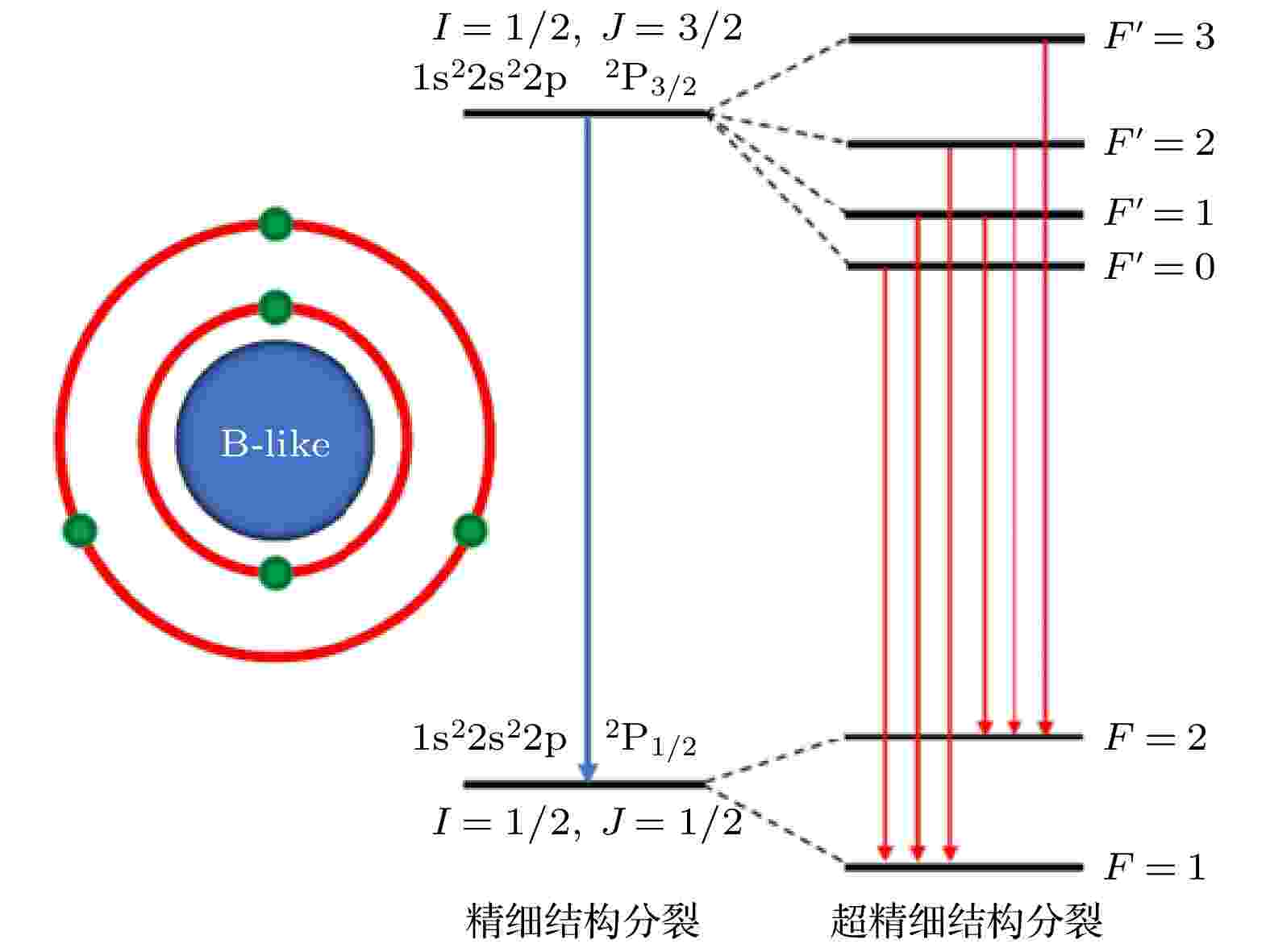
The precise measurement of the fine structure and radiative transition properties of highly charged ions (HCI) is essential for testing fundamental physical models, including strong-field quantum electrodynamics (QED) effects, electron correlation effects, relativistic effects, and nuclear effects. These measurements also provide critical atomic physics parameters for astrophysics and fusion plasma physics. Compared with the extensively studied hydrogen-like and lithium-like ion systems, boron-like ions exhibit significant contributions in terms of relativistic and QED effects in their fine structure forbidden transitions. High-precision experimental measurements and theoretical calculations of these systems provide important avenues for further testing fundamental physical models in multi-electron systems. Additionally, boron-like ions are considered promising candidates for HCI optical clocks. This paper presents the latest advancements in experimental and theoretical research on the ground state2P3/2—2P1/2transition in boron-like ions, and summarizes the current understanding of their fine and hyperfine structures. It also discusses a proposed experimental setup for measuring the hyperfine splitting of boron-like ions by using an electron beam ion trap combined with high-resolution spectroscopy. This proposal aims to provide a reference for future experimental research on the hyperfine splitting of boron-like ions, to test the QED effects with higher precision, extract the radius of nuclear magnetization distribution, and validate relevant nuclear structure models.

2024, 73 (20): 204203.
doi:10.7498/aps.73.20241128
Abstract +
Precision spectroscopy of lithium ions offers a unique research platform for exploring bound state quantum electrodynamics and investigating the structure of atomic nuclei. This paper overviews our recent efforts dedicated to the precision theoretical calculations and experimental measurements of the hyperfine splittings of6,7Li+ions in the $\,^3{\rm{S}}_1$ and $\,^3{\rm{P}}_J$ states. In our theoretical research, we utilize bound state quantum electrodynamics to calculate the hyperfine splitting of the $\,^3{\rm{S}}_1$ and $\,^3{\rm{P}}_J$ states with remarkable precision, achieving an accuracy on the order of $m\alpha^6$. Using Hylleraas basis sets, we first solve the non-relativistic Hamiltonian of the three-body system to derive high-precision energy and wave functions. Subsequently, we consider various orders of relativity and quantum electrodynamics corrections by using the perturbation method, with accuracy of the calculated hyperfine splitting reaching tens of kHz. In our experimental efforts, we developed a low-energy metastable lithium-ion source that provides a stable and continuous ion beam in the $\,^3{\rm{S}}_1$ state. Using this ion beam, we utilize the saturated fluorescence spectroscopy to enhance the precision of hyperfine structure splittings of7Li+in the $\,^3{\rm{S}}_1$ and $\,^3{\rm{P}}_J$ states to about 100 kHz. Furthermore, by utilizing the optical Ramsey method, we obtain the most precise values of the hyperfine splittings of6Li+, with the smallest uncertainty of about 10 kHz. By combining theoretical calculations and experimental measurements, our team have derived the Zemach radii of the6,7Li nuclei, revealing a significant discrepancy between the Zemach radius of6Li and the values predicted by the nuclear model. These findings elucidate the distinctive properties of the6Li nucleus, promote further investigations of atomic nuclei, and advance the precise spectroscopy of few-electron atoms and molecules.

2024, 73 (15): 150201.
doi:10.7498/aps.73.20240554
Abstract +
In the precision spectroscopy of few-electron atoms, the generation of high-intensity metastable helium atoms and helium-like ions is crucial for implementing experimental studies as well as a critical factor for improving the signal-to-noise ratio of experimental measurements. With the rapid development of free-electron laser (FEL) and technology, FEL wavelengths extend from hard X-rays to soft X-rays and even vacuum ultraviolet bands. Meanwhile, laser pulses with ultra-fast, ultra-intense and high repetition frequencies are realized, thus making it possible for FEL to prepare single-quantum state atoms/ions with high efficiency. In this work, we propose an experimental method for obtaining high-intensity single-quantum state helium atoms and helium-like ions by using FEL. The preparation efficiency can be calculated by solving the master equation of light-atom interaction. Considering the experimental parameters involved in this work, we predict that the efficiencies of preparing metastable 23S He, Li+and Be2+are about 3%, 6% and 2%, respectively. Compared with the common preparation methods such as gas discharge and electron bombardment, a state-of-the-art laser excitation method can not only increase the preparation efficiency, but also reduce the effects of high-energy stray particles such as electrons, ions, and photons generated during discharge. Furthermore, combined with the laser preparation technique, the sophisticated ion confinement technique, which can ensure a long interaction time between the ions and laser, increases the efficiency of metastable Li+and Be2+by several orders of magnitude. Therefore, the preparation of high-intensity metastable helium and helium-like ions can improve the measurement accuracy of precision spectroscopy of atoms and ions. A new experimental method, based on FEL, to study the fine structure energy levels 23P of helium, has the potential to obtain the results with an accuracy exceeding the sub-kHz level. Thus, the high-precision fine structure constants can be determined with the development of high-order quantum electrodynamics theory. In order to measure energy levels with higher accuracy, a new detection technique, which can reduce or even avoid more systematic effects, must be developed. For example, the quantum interference effect, which has been proposed in recent years, seriously affects the accuracy of fine-structure energy levels. If the interference phenomenon of spontaneous radiation between different excited states can be avoided in the detection process, the measurement accuracy will not be affected by this quantum interference effect. High-intensity metastable atoms or ions in chemical reaction dynamics studies also have better chances to investigate reaction mechanisms. In summary, the FEL preparation of high-intensity metastable helium atoms and helium-like ions proposed in this work will lay an important foundation for developing cold atom physics and chemical reaction dynamics.